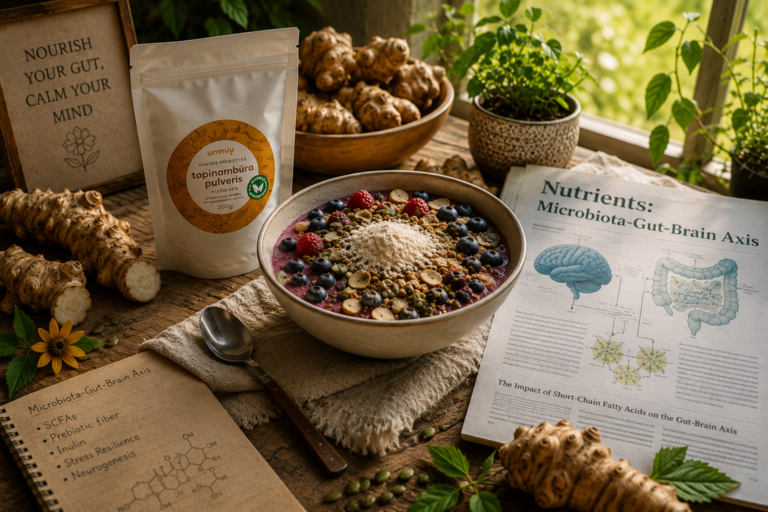
Could feeding your gut help your brain cope better with stress?
We often think about stress as something that happens primarily in the brain.
But increasingly, science is showing us that the story may also begin in the gut.
A fascinating study published in Nutrients investigated what happened when mice exposed to chronic unpredictable stress received preventive supplementation with Jerusalem artichoke (Topinambur) powder or inulin for 10 weeks.
The findings deserve attention. The researchers observed that supplementation with Topinambur or inulin was associated with:
- reduced anxiety- and stress-related behaviour
- protection of learning and memory functions
- increased hippocampal neurogenesis compared with stressed controls
- changes in the intestinal microbiota and protection against stress-associated dysbiosis
Why is this particularly interesting? Because Jerusalem artichoke is naturally rich in inulin-type fructans — prebiotic carbohydrates that reach the large intestine and become substrates for selected gut microorganisms. And this brings us to the increasingly important concept of the microbiota–gut–brain axis. The gut and the brain are not two isolated systems. They communicate through several interconnected pathways involving the nervous system, immune signalling, microbial metabolites and the hypothalamic–pituitary–adrenal axis involved in the stress response.
When our intestinal microorganisms ferment prebiotic fibres such as inulin, they can produce metabolites including short-chain fatty acids (SCFAs). These microbial metabolites are one of the mechanisms being investigated as part of the communication between the intestinal environment and the rest of the body.
So what could this mean for humans?
We should be careful here. This particular experiment was performed in mice, not humans. It does not prove that eating Jerusalem artichoke will prevent anxiety, depression or cognitive decline in people. But it adds another interesting piece to a much larger scientific picture. Our diet does more than provide calories and nutrients.
It also feeds our microbiome. And what we feed our microbiome may influence biological systems far beyond digestion. This is where whole-food sources of prebiotic fibres such as Jerusalem artichoke become particularly interesting. Instead of looking at fibre simply as something that “keeps digestion moving”, perhaps we should start thinking about certain fibres as biological substrates for an ecosystem living inside us. An ecosystem that interacts with metabolism, immunity — and potentially even the brain. This study does not give us the final answer. But it asks a very important question: Could supporting the gut microbiome before and during periods of chronic stress become one component of supporting our resilience?
More human clinical research is needed. Yet the emerging connection between prebiotics, microbiota and the gut–brain axis is becoming increasingly difficult to ignore.
Research:
Szala-Rycaj J. et al. The Influence of Topinambur and Inulin Preventive Supplementation on Microbiota, Anxious Behavior, Cognitive Functions and Neurogenesis in Mice Exposed to the Chronic Unpredictable Mild Stress.
Nutrients. 2023;15:2041. DOI: 10.3390/nu15092041.